
Diorama How-To
Pick Your Scale: 1:12 and 1:24 Explained for a First Diorama
What 1:12 and 1:24 really mean, how big a room gets at each scale, and which one makes a calmer first diorama. Simple maths, no guesswork.
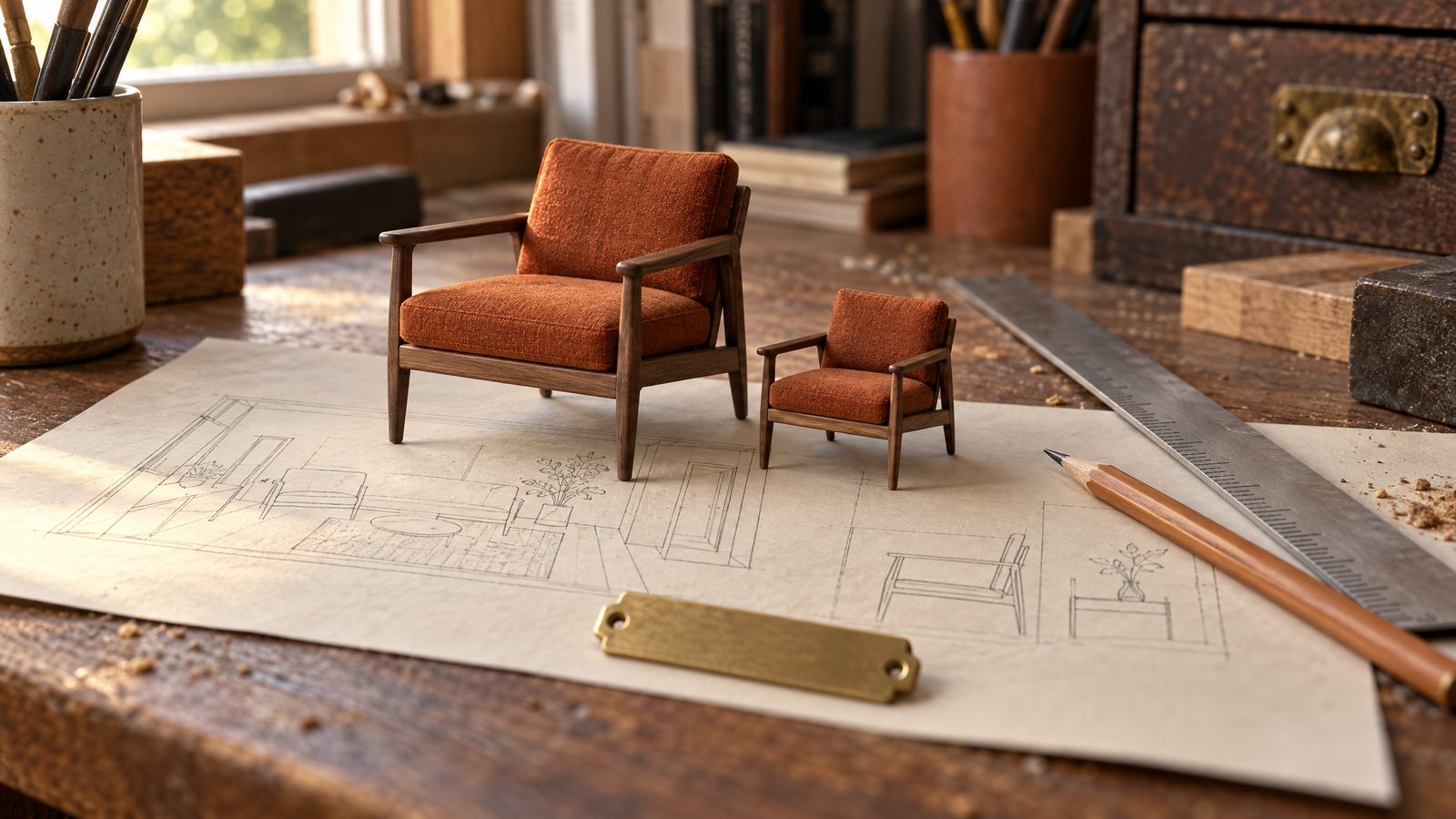
Scale is the first real choice you make in a diorama, and it quietly shapes every choice after it. It decides how big your box is, how fiddly the work feels and which bits and pieces will fit. The good news: you only need to understand one idea, and the rest is simple division.
What a scale actually means
A scale like 1:12 means one unit in your miniature stands for twelve of the same unit in real life. One centimetre in the model is twelve centimetres in a real room. One inch is one foot, which is why 1:12 is also called "one inch scale".
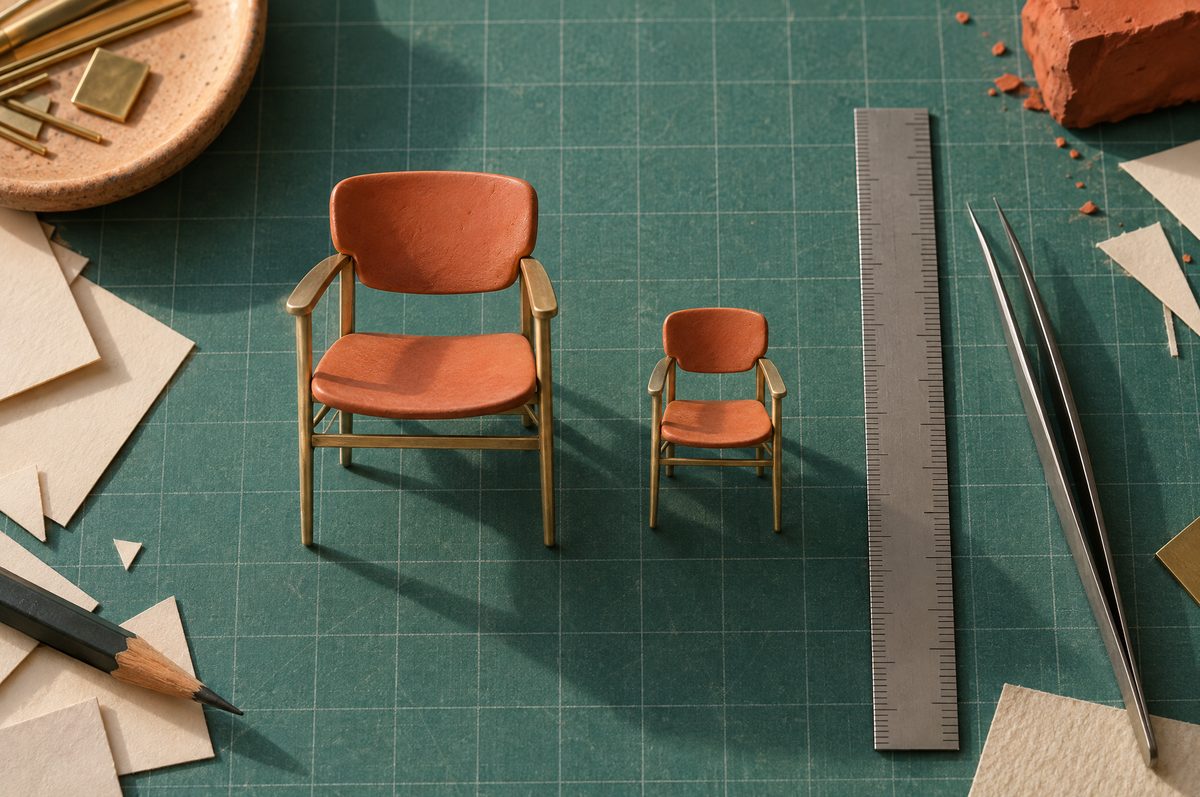
1:24 works the same way, just smaller. One centimetre in the model stands for twenty-four in real life. Everything is half the size of 1:12, so it is often called "half scale".
To turn any real measurement into a scale measurement, divide by the scale number. That is the whole trick.
The maths, shown
Here is a real room and a few real objects, turned into both scales. All real sizes are typical examples, so measure your own furniture if you want to copy it exactly.
| Real thing | Real size | At 1:12 | At 1:24 |
| Ceiling height | 240 cm | 240 ÷ 12 = 20 cm | 240 ÷ 24 = 10 cm |
| Doorway height | 200 cm | about 16.7 cm | about 8.3 cm |
| Dining table height | 75 cm | 6.25 cm | about 3.1 cm |
| Chair seat height | 45 cm | 3.75 cm | about 1.9 cm |
| A person | 180 cm | 15 cm | 7.5 cm |
| A hardback book | 24 cm | 2 cm | 1 cm |
Look at the last row. A book at 1:12 is two centimetres tall, which you can make with your fingers. At 1:24 it is one centimetre, which you can still make, but you will reach for tweezers far more often.
How big your box gets
Say you want to stage a small real room, 360 cm wide, 300 cm deep and 240 cm high.
- At 1:12: 360 ÷ 12 = 30 cm wide, 300 ÷ 12 = 25 cm deep, 240 ÷ 12 = 20 cm high. That is about the size of a shoebox standing on its side.
- At 1:24: 15 cm wide, 12.5 cm deep, 10 cm high. That fits on a bookshelf with room to spare.
Neither is wrong. It depends on where your finished piece will live and how much detail you want to put in.
Why 1:12 is the friendly first choice
For a first room box, 1:12 is the scale we suggest most often. Here is why.
- Your hands can keep up. Books, cushions and teacups are big enough to shape with your fingers.
- Mistakes are forgiving. A blob of glue or a slightly crooked cut is easier to hide or fix.
- Everyday materials fit. Coffee stirrers become floorboards, cereal box card becomes furniture, scraps of cotton become cushions.
- Ready-made pieces are easy to find. 1:12 is the classic dollhouse scale, so if you want to buy one chair and make the rest, you have plenty of choice.
The trade-off is size. A full 1:12 room takes up real space on a shelf, and it needs more material to fill.
When 1:24 makes more sense
1:24 suits you if:
- you have a small home or one shelf to spare,
- you like quick, compact builds,
- you are making a book nook or a shadow box that has to be shallow,
- you enjoy fine work and have good light and a steady hand.
A 1:24 room can feel very jewel-like. It just asks a little more patience, and a magnifier helps.
Other scales you will see
You will meet other numbers as you browse. 1:35 is common for military and vehicle models. 1:87 (often called HO) is a model railway scale, where a person is about two centimetres tall. They are lovely, but they are less suited to furnished rooms full of soft things. For a first tiny interior, stay with 1:12 or 1:24.
The one rule: stick to one scale
Once you choose, keep everything in the box at that scale. A 1:24 vase on a 1:12 table looks oddly wrong, even to people who could not tell you why. If you buy or find a piece, measure it first. Divide its height by your scale number and check it against the real thing it is meant to be.
There is one exception you may meet later: forced perspective, where things far back are deliberately smaller to fake depth. It is a fun trick for a second or third build, not something to stumble into by accident.
Try this today: the cardboard test
Before you spend anything, try this. It takes ten minutes.
- Pick one piece of furniture in your home, such as a dining chair.
- Measure its height, seat height and width.
- Divide each measurement by 12, then by 24.
- Cut both versions as flat shapes from scrap card.
- Stand them up on your table and look at them at eye level.
Which one makes you want to keep going? That is your scale. Many people feel it instantly.
A quick scale cheat sheet
- To shrink: real size ÷ scale number = model size.
- To check: model size × scale number = real size.
- At 1:12, 1 cm in the model = 12 cm in life.
- At 1:24, 1 cm in the model = 24 cm in life.
- Write your scale on a sticky note and keep it on your mat. You will be surprised how often you look at it.
If you would like a scale ruler to keep on the bench, the free Miniature Designs Starter Guide has one, with cut-out rulers for 1:12 and 1:24 and a few printable miniatures to try them on.
Ready when you are
Picking a scale feels like a big decision, but it is really just the first line of your plan. Choose the one your hands enjoy, write it down, and measure everything against it. Your tiny room is already a little more real.